
Los Zetas (also known as the Zetas Cartel or Cártel de los Zetas), once Mexico’s most feared and militarized criminal syndicate, pioneered extreme violence in the drug trade during the 2000s and early 2010s. As of February 2026, Los Zetas no longer exists as a unified organization. It fragmented into splinter groups following leadership losses and internal wars, with remnants operating under new banners. The most prominent successor, the Cártel del Noreste (CDN, Northeast Cartel), explicitly recognized as formerly Los Zetas, has been designated by the United States as a Foreign Terrorist Organization (FTO) and Specially Designated Global Terrorist (SDGT) since February 2025. Other offshoots, like Los Zetas Vieja Escuela (Old School Zetas) and smaller cells, persist regionally but lack the original group’s national reach. The name “Los Zetas” endures in references to these violent holdouts, linked to ongoing drug trafficking, extortion, migrant smuggling, and brutal enforcement in northeastern Mexico.
Origins and Militarization
Los Zetas formed in the late 1990s as the armed wing of the Gulf Cartel (Cártel del Golfo, CDG). Founded by Arturo Guzmán Decena (“Z-1”), a former Mexican Army special forces soldier (from the elite Grupo Aeromóvil de Fuerzas Especiales, or GAFE), it recruited deserters and ex-military personnel for protection and enforcement. Under Osiel Cárdenas Guillén of the Gulf Cartel, Los Zetas became infamous for paramilitary tactics, heavy weaponry, and psychological terror, beheadings, torture videos, and massacres, to intimidate rivals and authorities.
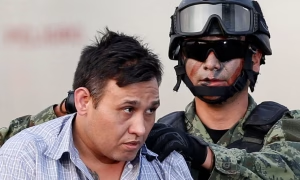
By 2010, Los Zetas broke away from the Gulf Cartel amid disputes, becoming an independent cartel. Led by figures like Heriberto Lazcano (“Z-3,” killed 2012) and the Treviño Morales brothers—Miguel Ángel (“Z-40,” arrested 2013) and Omar (“Z-42,” arrested 2015), it expanded aggressively. At its peak (around 2010–2012), it controlled vast territories across 11+ states, diversified into extortion, fuel theft (“huachicoleo”), kidnapping, and human smuggling, and challenged larger groups like the Sinaloa Cartel.
Peak Violence and Tactics
Los Zetas redefined cartel brutality: public displays of mutilated bodies, attacks on journalists and officials, and events like the 2010 San Fernando Massacre (72 migrants killed) and the 2011 Allende Massacre (hundreds disappeared). Its military-style structure, ranks like “Z” designations, training camps, and use of RPGs/drones, made it uniquely dangerous. It trafficked cocaine, marijuana, methamphetamine, and later heroin/fentanyl precursors, generating billions while terrorizing communities in Tamaulipas, Nuevo León, Veracruz, Coahuila, and beyond.
Fragmentation and Decline
The “kingpin strategy”, targeting leaders, accelerated collapse:
- Key arrests/killings (Lazcano 2012, Z-40/Z-42 2013–2015) sparked infighting.
- By the mid-2010s, it splintered into factions: Cártel del Noreste (CDN) (led by Treviño family remnants, centered in Nuevo Laredo), Los Zetas Vieja Escuela (Old School Zetas, allied variably with Gulf Cartel against CDN), Los Talibanes, and smaller groups like Sangre Nueva Zeta.Most original leaders were captured, killed, or extradited (e.g., Treviño brothers to U.S. in 2025 batches).
- By the late 2010s, Los Zetas as a cohesive entity ceased; influence waned as rivals (CJNG, Sinaloa) expanded.
Current Status and Remnants (as of February 2026)
Los Zetas’ legacy lives through fragments, primarily:
- Cártel del Noreste (CDN): The strongest heir, based in Tamaulipas/Nuevo León (Nuevo Laredo stronghold), involved in drug/arms trafficking, migrant smuggling, extortion, and violence.
- Designated FTO/SDGT in 2025; high-ranking members sanctioned (e.g., May 2025). It battles Gulf Cartel factions, CJNG incursions, and others. Recent U.S. transfers (e.g., January 2026 batch including CDN/Zetas-linked figures like “Z-27” Juan Pedro Saldívar Farías) target its networks.
- Other cells: Vieja Escuela remnants in Tamaulipas/Veracruz/Zacatecas; smaller groups in San Luis Potosí/Quintana Roo. These are hyper-local, focused on regional crimes rather than national expansion.
Violence in former Zetas areas (Tamaulipas) remains high due to factional clashes and Gulf Cartel rivalries, though less intense than 2010s peaks. Mexico’s transfers of dozens of cartel figures to U.S. custody (92+ since 2025, including Zetas/CDN members) reflect intensified U.S.-Mexico cooperation amid fentanyl pressures.
Impact and Legacy
Los Zetas pioneered militarized cartel warfare, inspiring imitators (e.g., CJNG’s paramilitary style) and escalating Mexico’s security crisis. Its tactics contributed to thousands of deaths, mass disappearances, and eroded state control in border regions. The group’s fragmentation illustrates the limits of decapitation strategies: while weakening hierarchies, it creates volatile splinters fueling localized terror.
Today, Los Zetas symbolizes the evolution of Mexican organized crime—from family-based syndicates to ex-military enforcers to decentralized, hyper-violent networks. Though diminished, its remnants (especially CDN) pose ongoing threats to border security, U.S. drug flows, and regional stability, under heavy scrutiny via terrorist designations and cross-border enforcement.